The realm of data entry is evolving with the integration of Artificial Intelligence/AI and machine learning. New updates in artificial intelligence and machine learning are rolling out progressively and are conquering the BPO data entry sector. With the help of machine learning, BPO data entry is creating waves in the outsourcing world by seamlessly providing human-level efficiency. Recently, data entry service providers began to incorporate AI and machine learning in data entry BPO services, and the impact is nothing short of efficiency. With the integration of this powerful duo, BPO operators can drag the most out of their services and work towards delivering more streamlined services. However, these technologies are not just integrations to smoothen workflow, but also integral components of data entry processes today. Come tune in and explore the impacts of AI and machine learning in data entry BPO services.
Automation with Machine Learning and AI in BPO
Artificial Intelligence is a game-changer in the world of BPO services. However, the combination of machine learning and AI in BPO speaks for boundless innovation. With their revolutionary amalgamation, data entry has become effortless yet more qualitative than ever. By integrating AI and machine learning in BPO, service providers reduced the traditional data entry challenges and unlocked operational efficiency. Let’s have a look at the major BPO automation technologies operators use.
Optical Character Recognition(OCR)
BPO service providers leverage OCR technology in BPO automation. Just like machine learning automation technologies like IDC, this tool helps in extracting information from physical as well as digital documents. By leveraging AI-powered OCR technology, data entry service providers convert data from ordinary formats to machine-readable formats, which aids in data entry automation.
Intelligent Data Capture(IDC)
Intelligent Data Capture utilizes AI and machine learning automation to extract data from physical datasets like documents. This tool helps in data entry automation by capturing information from scanned documents and printed media, leveraging OCR technology. However, this one takes a step beyond OCR by analyzing the context. That is, IDC understands, organizes, and interprets data relevant to the context.
Natural Language Processing(NLP)
Natural Language Processing is a branch of AI that utilizes machine learning for automation techniques. This technology is focused on analyzing and interpreting human languages. Today, organizations have large quantities of data in voice and text formats. Data entry operators use this technology to read and respond to data in real-time, by analyzing the context and intended sentiments.
Impact of Machine Learning and AI in BPO
Increased Efficiency through Automation
Artificial intelligence facilitates the automation of repetitive tasks in BPO. As we are aware, data entry involves a huge amount of data to be entered and this mundane task can be completed within short turnaround times with data entry automation. Moreover, machine learning in data entry BPO services enhances the process of data entry by analyzing and responding just like that of humans.
Error-Free Data Entry
Error-free data is the core component of successful businesses. Data entry mistakes can cost heavily and human errors are inevitable, and this results in customer dissatisfaction. Leveraging AI-powered tools in Data Entry BPO services helps operators deliver data entry services with fewer errors, avoiding redundancies. Additionally, machine learning BPO tools learn from patterns and mitigate the risk of errors from time to time.
Operational Cost Reduction
By utilizing AI and machine learning in data entry BPO services, operators can reduce the cost of hiring and maintaining a large team of manual data entry specialists. There is an initial investment in technologies here. But the resulting efficiency will speak for your investment. Moreover, you can scale up or scale down the tools according to your working modes and requirements.
Better Customer Experience
Customer satisfaction is a foundational aspect behind the success of any business. AI and machine learning in BPO data entry services give you opportunities to provide tailored services. By learning customer behaviors, machine learning enables businesses to give customized solutions and meet the expectations of the clients. Moreover, customized solutions result in better customer experiences.
Predictive Analytics
As today’s businesses are heavily driven by data, AI and machine learning are highly beneficial in data entry BPO services. By analyzing past data, AI can predict customer behavior and market trends for the future. This will enable BPO data entry service providers to make informed decisions and work for the future of the business. In reality, BPO automation, especially data entry automation works wonders if you are up for automating your workflow. Moreover, it reduces the risk of overestimations and irrelevant predictions.
Improved Data security
Data security is a top priority in data entry services. As they handle sensitive information of diverse clients, managing them properly and keeping them secure is of paramount importance. Machine learning and Artificial Intelligence in BPO Data Entry services detect even minor security threats. But, how does it work? Simply put, machine learning in BPO learns from past data, spots suspicious activities, and takes protective measures to safeguard sensitive data.
Future of Data Entry with AI and Machine Learning
The future of data entry BPO looks promising with the immense opportunities technologies provide. Moreover, organizations have witnessed the vitality of integrating digital tools in BPO. As BPO automation is gaining momentum with its revolutionary features, the time is in favor of the service providers than ever before. Indeed, the potential of AI and machine learning BPO is going to reshape the outlook of the BPO data entry industry. Furthermore, we can expect advancements such as speech-to-text automation in BPO, in the upcoming years. However, the major thing we must address here is the company’s adaptation to advanced tools. While AI automates repetitive routine tasks, machine learning refines the process by analyzing datasets. In brief, leveraging this duo can enhance the accuracy and efficiency of BPO data entry services.
Bottom Line
With the combination of AI and ML, operators can bring up intricate projects and deliver them efficiently, without uncertainties. Also, the combined strength of these AI and ML makes operators efficient enough to provide services that meet the demands of today’s data entry needs. It’s important to realize that the world is on the run to unlock more technology. Although artificial intelligence is prominent, machine learning benefits in BPO are notable as well as reliable. And, adopting digital tools to fit in the ever-evolving landscape of data entry is also critical. We have a note for the outsourcing customers, partner with an advanced service provider! Leveraging technology is so crucial for staying current and unlocking efficiency. Want to partner with a top-tier service provider? Connect us at suppport@offshoreindiadataentry.com.
In the past decades, BPO outsourcing has become the choice of businesses because of the multitude of advantages it offers. Businesses opt-out offshore BPO as it is a means for them to concentrate more on their core tasks. By far, India is one of the top markets any business can rely on to meet their Business Process Outsourcing needs. When we look into the past years, the growth of BPO outsourcing to India is remarkable. And it is driven by certain factors that businesses consider while hiring an offshore BPO team. Let’s dive in and learn how India stands as a significant choice for BPO outsourcing services!
Top Reasons for Outsourcing BPO Services in India
Access to the Greatest Professional Pool
India boasts a large pool of expert professionals with great technical skills. The country is one of the world’s largest exporters of software. While considering BPO outsourcing, India has the greatest count of skilled professionals with proven experience. One of the major things that businesses find attractive while outsourcing to India is its status as the world’s largest English-speaking country. That is, seamless communication is guaranteed across all channels. Annually, tons of graduates are added to the professional sphere. This technologically advanced young population makes India an ideal location to outsource your business needs.
Cost-effective Yet High-Quality Services
Everyone, including you, is seeking services that are value for money. Indian operators offer cost-effective outsourcing services. If you hire outsourcing professionals from developed countries, the cost you spend on them will be several times greater than that of Indian professionals. Furthermore, businesses can significantly save on infrastructure and hiring along with services. Besides, spending low in India will give you high returns as you can spend more time implementing new measures.
Round-the-clock Assistance
Indian BPO operators offer 24*7 services. The time zone difference hits here! While comparing the time zone of India with US and European countries, the difference ranges from 5 to 12 hours. And, providing customer care assistance on time ensures better customer satisfaction. So, providing round-the-clock service is a win-win for the business as they don’t need to hire employees for night shifts and can provide timely customer support. BPO outsourcing in India helps you provide a better customer experience through uninterrupted services and thereby ensures customer retention.
Advanced Technological Support
Access to advanced technologies makes India a leading destination for outsourcing services. India has heavily invested in technological advancement and Offshore BPO outsourcing companies in India always provide services incorporating the latest technologies. Besides updated service, they always ensure that their employees are knowledgeable about the emerging innovations in the industry. Operators utilize technologies like Artificial Intelligence and automation to streamline their operations and deliver high-quality services in a short time.
Risk-Free Advanced Services
Outsourcing to India avoids the risk factors in the process as India houses established BPO operators. By making use of the quality services from the country, businesses can ensure smooth workflow without the risk of inaccuracies and inefficiencies. Also, service operators come up with risk mitigation strategies to tackle the challenging situations that may come their way. These measures make the businesses feel secure and keep their focus more on core tasks to grow the business.
India, The Ultimate Destination for BPO Outsourcing
Indian operators offer top-notch solutions for Business Process Outsourcing needs from across the world. From cost saving to timely service delivery, BPO outsourcing to India is advantageous to every business, regardless of the industry. By collaborating with offshore BPO operators in India, any business can thrive in its respective field as it can focus on the key functions. Businesses continue to seek operators who can streamline and process their non-functional tasks. And India continues to lead the global market of BPO outsourcing.
So, the benefits of BPO outsourcing to India are many. To turn all your routine tasks into an easy process, and ensure your workflow, connect with a BPO outsourcing service provider in India. Tired of looking for the best BPO outsourcing company in India? Connect and collaborate with info@offshoreindiadataentry.com and avail cost-effective and exceptional offshore outsourcing services.
Healthcare is one of the top industries that is undergoing rapid changes. The rising patient demands, growing regulatory pressures, and the continuous requirement for operational efficiency force the healthcare industry to seek smart and sustainable solutions. A similar solution that is gaining prominence is healthcare outsourcing. Particularly, healthcare BPO services in India are becoming a vital approach for organizations seeking to simplify operations, mitigate expenses, and focus on patient care.

Healthcare BPO services enable organizations to unburden their administrative tasks like medical billing, coding, claims processing, and patient data management to expert service providers. By outsourcing, you can free up your in-house staff and also ensure that these crucial tasks are managed efficiently. India has become the favorite outsourcing hub for healthcare outsourcing because of its highly talented workforce, affordable solutions, and ability to adapt to the changing healthcare technologies. But, why choosing the best healthcare BPO services in India is a strategic approach? Let’s explore!
Access to Skilled Workforce
Healthcare organizations worldwide struggle to hire and retain skilled professionals to manage complicated processes including medical coding, billing, and managing claims. When you burden internal resources with routine and tedious tasks resulting in errors and inefficiencies that affect both operations and patient care. As a result of choosing the best healthcare BPO services in India, your healthcare firm gains access to an expert workforce. Indian BPO providers house certified resources who are adept in core healthcare functions, including medical billing and coding, patient data management, and insurance claims processing. They get meticulous training and stay current with the new technology trends and healthcare regulations.
All these matters because of the crucial role expertise has in the seamless functioning of healthcare operations. When talented experts handle your back-end processes, you will benefit from fewer errors, faster turnaround times, and enhanced service quality.
Cost-Efficiency Without Compromising Quality
The current healthcare scenario requires organizations to maintain a delicate balance between handling strict budgets and keeping up top-notch services. In Western countries, operational expenses are increasing. This makes healthcare providers challenging to deliver quality care cost-effectively. A significant benefit of outsourcing healthcare services to India is the cost-efficiency they provide. When you outsource non-core healthcare tasks to India, you can save operational expenses without compromising on quality. The BPO service providers in India are experts in delivering exceptional services at a small cost as compared to managing this process in-house.
Smooth Technology Integration
It is essential for healthcare organizations to adopt and integrate the latest technologies in the industry. This is necessary to remain top of the competition. However, the process of integration and application of these technologies might be complicated and time-consuming. This is mainly due to your internal team’s lack of expertise in technology. The healthcare BPO providers in India have high expertise in consolidating advanced technologies into their operations. They are experts in handling patient information through secure electronic healthcare records (EHR) systems or establishing telemedicine assistance. Indian BPO providers can manage routine tasks, data security, regulatory compliance, and system interoperability. This guarantees that your firm operates effectively while remaining compliant with healthcare laws and regulations. Through adept support, Indian healthcare assists you in maximizing the advanced technology trends to remain competitive.
24/7 Operational Support
Healthcare processes have to function 24/7 because the patients require support at times. Moreover, major tasks including claims processing, insurance verification, and patient scheduling have to be done on the same day and cannot wait until the next business day. This may pressure internal teams as they may lack sufficient resources to deliver round-the-clock support. However, outsourcing healthcare services to India offers a strategic benefit which is the time zone difference. The time difference from India, the USA, and Europe helps Indian BPO providers to deliver full-time operational support. This enables you to complete the critical tasks overnight resulting in quicker processing times and seamless operations. Indian BPO providers ensure that tasks like patient inquiries, insurance claim verifications, or administrative support, are managed faster.
Compliance with Global Healthcare Standards
To ensure patient privacy and data security, healthcare providers must stick to the industry regulations including HIPAA and GDPR. The BPO companies in India are aware of the significance of compliance with healthcare standards worldwide. The best healthcare BPO services in India adhere to stringent protocols. They ensure that every task, including medical coding and patient data handling, fulfills the standards of privacy and security. They employ the latest encryption and secure data management systems to safeguard confidential patient data. Also, the healthcare BPO providers in India, stay current with the regulatory updations, making sure that you stay compliant every time.
Outsourcing to India – A Strategic Decision
India is considered the best service provider when it comes to outsourcing healthcare processes. Additionally, Indian BPO providers provide unparalleled benefits including, access to an expert workforce, cost-efficiency, seamless technology integration, 24/7 support, and strict compliance. Partnering with the best healthcare BPO services in India enables healthcare organizations to save costs, enhance service quality, stay technologically current, and ensure compliance with global standards. Outsourcing healthcare BPO is a strategic decision that assists in simplifying operations and providing better patient care.
Are you looking to streamline your healthcare processes? Explore the best healthcare BPO services in India. Connect with us at support@offshoreindiadataentry.com to know more.
In the very highly competitive business world, the Business Process Outsourcing(BPO) sector is vying for operational efficiencies and accurate performances. Among these is data automation, the biggest boon for BPO today. This innovation automates many data-driven processes, giving clients the best combination of service speed, accuracy, and much better service. This blog covers the prominence of data automation’s advantages within BPO, as it relates to increasing efficiency and accuracy.
What is Data Automation in BPO?
Data automation relies upon several technologies including artificial intelligence(AI), machine learning(ML), and robotic process automation(RPA), to work out mundane, repetitive, and time-taking tasks. Under BPO’s working process, data entry, data processing, document management, and report generation remain the easy targets for these automated bindings. With such fields being now handled with automation, many of the errors that occur could be brought down to zero.
Greater Efficiency of Operations
Operative efficiency is one of the biggest advantages brought about by data automation in BPO-huge enhancement in operative efficiency. Numerous people would think that labor-intensive processes are slow and prone to errors. BPO companies, therefore can handle bigger volumes of work in less time and thereby shoot up project turnarounds.
Automation speeds up data processing and does even complex bookkeeping tasks within seconds that otherwise might require many hours.
Reduced turnaround time improves productivity within a given organization.
Such automation systems work 24 hours a day, 7 days a week, and require no timeouts, providing continual operation and output. The use of automation technologies allows BPOs to beat deadlines, extend their tepid customer base, and make better profits in the process.
Improved precision and quality of data
Manual processing and entry are prone to errors. Data automation eliminates these inaccuracies, giving veritable results that cannot be faulted. Automated systems work according to the rules established earlier, thus the risk of mistakes remains low.
Automated processes ensure perpetual and ensured accuracy, stability and reliability of data over time.
These benefits enhance the quality of services provided to clients that establish good relationships based on verified data for sound decision-making.
Cost Optimization
In BPO, substantial cost savings can be achieved through data automation. The company can reduce labor dependence, thereby reducing the cost of operation, through the automation of repetitive work activities. Automation tools can perform an entire gamut of tasks that could otherwise require a large number of workers.
Labor costs are also reduced since automation reduces the need for large teams to handle data-related tasks.
With time, business acquires high returns on investment (ROI) since more efficiency and output are acquired without necessarily hiring continuously.
It provides high-quality services at a reduced rate and thus helps gain new customers and retain the existing ones for a BPO firm that wishes to be ahead of the game.
Scalability and Flexibility
Automation also provides unparalleled scalability, so data automation BPO companies comfortably manage rising volumes of data. Whether maintaining hundreds of entries or millions, an automated system can scale up to keep pace with an expanding workload without requiring hands-on adjustments.
This easily makes it scalable both up and down, making it easy to adjust the business needs without having to hire more staff.
They could handle enormous amounts of data and still do it fast and without lost quality.
This flexibility allows BPO companies to grow their operations without continuously expanding their workforce, ensuring smooth, cost-effective scaling.
Incremented Compliance and Security
Another benefit of data automation in BPO is greater compliance with industry standards and better data security. Because automated systems operate within specific standards, the data is processed under the best industry requirements that minimize the possibility of non-compliance.
Automated systems follow strict protocols, ensuring consistent adherence to regulatory requirements.
Self-service platforms utilize data security features, such as protecting sensitive information from being accessed without permission.
Because of this, the minimized human intervention requirement minimizes the possibility of data breaches and handling errors.
To the BPO company dealing in sensitive information like financial records or medical, automation provides the necessary security and regulatory compliance to protect both the company and its clients.
Conclusion: The future of BPO lies in data automation.
As businesses continue to multiply data production, BPO data automation demand will increase. With all these factors of efficiency and accuracy along with the help of cost-cutting measures and scalability, automation is a must in BPO companies to remain competitive.
BPO companies can bring service quality improvement, adhere to clients’ demands even better, and future-proof their operations if they take on automation technologies. Whether you’re looking to improve efficiency or boost data accuracy, automation happens to provide the perfect answer to today’s data-driven competitive business environment.
The fast-paced business world derived immense benefits from changing the paradigm of data maintenance processes over the slow-paced models of yore. Outsourcing of data entry services in India is proving to be handy amongst many firms. A host of reasons speak to the advantages of outsourcing to many businesses.
Affordable Data Entry Solutions for Businesses
One of the primary benefits of online data entry services in India is that it is cheap. Hiring full-time personnel might create an undue burden on a firm and its finances when the salary, benefits, and training costs all gallop in. Outsourcing provides access to premium data entry services, fetching value for money that would otherwise be unutilized.
Expert Access to Skilled Data Entry Specialists
In India, you have a lot of experts employed in this field, so the very high possibilities of providing a very wide range of services would be available to you. Most of these service providers employ trained professionals versed with the latest software and tools. This enables you to carry out data handling accurately and expediently, thereby greatly reducing the chances of committing errors. After all, it is this expertise that assures you of the safety of your data.
Flexible and Scalable Data Entry Services
Another benefit is flexibility: outsourcing data entry allows you to have that. Whether your assignment is short- or long-term, online data entry services in India are always there to assist you. It becomes extremely easy for a business to grow, making modifications as it builds up, without the worry of having to independently hire and train its employees.
Prioritizing Core Competencies through Outsourcing
Outsourced data entry allows business processes to be more appropriately focused on their core competencies. The initial handing out of these business functions may consume much of your valuable time and resources. Outsourcing enables your team to focus on those strategic and forward-looking initiatives that will drive growth and improvement. This shift can lead to increased productivity and success for your business.
Robust Data Security in Data Entry Operations
Data security is one of the primary concerns for any business. Reliable providers of online data entry services in India give a lot of attention to data protection. They apply thorough security measures to ensure that your information can no longer be compromised by unauthorized access. With a trustworthy outsourcing partner, you will get better security.
Rapid Turnaround Times for Data Entry Tasks
In today’s cosmopolitan business environment, fast task completion is critical. Most online data entry services in India are operational twenty-four hours a day, ensuring that projects are completed within the given time. As teams work round the clock, the results are guaranteed to be quicker, allowing you to make decisions based on the most up-to-date data.
Innovative Technology and Tools for Data Entry Excellence
In ensuring high-quality output, Indian data entry service providers use the latest technology. This equipment greatly adds to their operational efficiency and accuracy, minimizing errors and ensuring quality enhancement. The proper and timely use of such tools enhances efficiency, accuracy, and performance.
Conclusion
Choosing online data entry services is a smart move for all kinds of businesses looking for maximization of efficiency and cost savings. Outsourcing data entry work can thus enable flexibility, and higher productivity, and allow them to direct their focus on core activities. Other compelling reasons to outsource include robust data security and speedy turnover.
Engaging online data entry services is a sensible decision in the face of globalization and the extent to which the labor force is versatile and more inclined to invest in technology and value addition to the company’s processes. With this transition, you are striving to survive but also to place a show in front of your arch enemy and devise ways to be concerned about others, like employing competitive tactics in such a way that becomes thrusts above their enterprises.
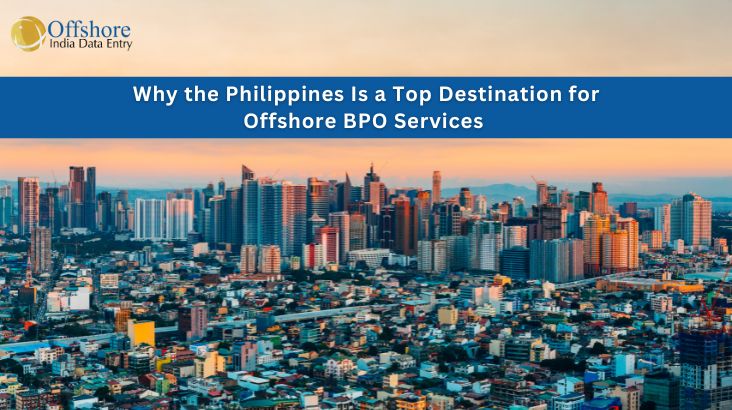
The Philippines has gained recognition in recent times as a leading Offshore Business Process Outsourcing destination. Its energetic manpower, hospitable environment, and dedication to service quality have made the Philippines a place of convenience for operators planning to improve operations while minimizing costs. In this blog, we will explore the reasons behind the Philippines being the one-stop shop for outsourcing.
1. Fluency in the English Language and Communication Skills
The notable advantage of outsourcing to the Philippines is the command in the English language that the Filipino population has. This means that one can expect those who work in offshore BPO in the Philippines to attain a fairly high level of proficiency in terms of effective communication and eloquence.
They also combine fluency in English with exceptional communication skills. They can convey ideas clearly, making for a generally cordial and approachable crowd. This is of utmost importance in customer service roles where addressing and understanding customer concerns is vital. It is this ability to connect with clients that has made BPOs in the Philippines very competitive on a global front.
2. Cultural Affinity
The Philippines has a unique cultural affinity toward Western countries, especially the United States of America. This cultural inclination finds one of its crucial bases in offshore business process outsourcing services in the country. Filipinos are famed for their hospitality, friendliness, and empathy-first traits, which really bring out their potential in dealing with customers.
Many Filipinos have been exposed to Western media from a young age, which allows them to connect with the foreign tastes and expectations of international clients. Such cultural homogeneity again lets the BPO companies in the Philippines render services that are pleasant for the clients and make them a favored choice for companies looking for credentialed and competent partners in outsourcing.
3. Cost-Effectiveness
Cost is truly one of the biggest considerations when outsourcing features and functions. Concerning its economy, the Philippines provides cost-effectiveness without compromising quality. Labor overhead here is mass affordable as compared with other Western nations to provide them a certain form of keeping operational costs low while gaining the best of services from the offshore BPO agents. The Philippine government also supports this industry by providing various forms of incentives to foreign investors in the form of something like tax reductions and lower corporate taxes. This spirit fosters a great deal that makes outsourcing to the Philippines entertaining as far as companies are concerned in optimizing their budgets and benefiting from quality offshore BPO services.
4. Skilled Workforce
The Philippines offers an abundance of skilled professionals in various fields in IT, finance, healthcare, and customer service. The education system of the country has always churned out talents and would find success in offshore BPO services yet again. Moreover, many Filipinos seek higher education and specific training that is useful for BPO functions. Thus, there exists a continual pool of qualified candidates ready to be tapped into for any and all industry needs. Therefore, these companies will generally be confident that good partners can be found whenever they decide to migrate to offshore or BPO services in the Philippines.
5. The internal strength of the BPO
In recent years the Philippines has invested much in the infrastructure that sustains offshore BPO. Metro centers like Manila, Cebu, and Davao have risen up as business centers having sophisticated office buildings fitted with state-of-the-art technologies.
Stable internet connection and necessary services are available, which is quite critical for the efficient running of businesses. Such commitment by the government to uphold the infrastructure also serves to strengthen the perception that the Philippines shall maintain its favorable position as a destination country for offshore BPO services.
6. Government Support
Government support for offshore BPO has been acknowledged in the Philippines as a proven driver of economic activity. Various policies are in place to promote the industry. This creates an atmosphere conducive to foreign investment by making it easy to register businesses and get permits. This kind of support establishes an atmosphere conducive for companies to set up businesses based on offshore BPO services in the Philippines.
Final Thoughts
Based on this discussion, with its excellent command of English, cultural compatibility, cost-effectiveness, able workforce, infrastructure, and government support, the Philippines rightly deserves its position as an offshore BPO hub. As more and more companies tend toward improving efficiency and cutting costs, outsourcing to the Philippines becomes a favorable option. This is a partnership of advantage for businesses aiming at achieving business objectives with high-quality service to their customers. For this reason, the Philippines remains an ultimate option for firms in search of dependable self-service-based solutions.
With the numerous demands and high expectations for cutting down on cost and operations, modern businesses search for different solutions. Some opt for outsourcing to a BPO company, which can be very helpful in providing customer care services, data entry, and accounting support, allowing businesses to maximize their core activities. But finding the right BPO partner is not an easy task. Here is a step-by-step guide to help you make the best decision.
What is BPO
BPO is when one hires a third party company for certain business functions. This can include customer service, payroll management or processing and data handling. This benefits in saving costs and leveraging expert capabilities that may not exist in house.
Why Use a BPO Company?
Cost Savings: Outsourcing often leads to reduced operational costs. BPO firms are likely to have less labour costs to offer services at a cheaper cost than it would be for an in-house team.
Focus on Core Functions: Allowing a BPO company to manage non-core work lets a business concentrate on what it does best and therefore improves its general productivity.
Expertise and Experience: BPO firms specialize in specific services and use trained professionals who bring valuable knowledge and experience to your business processes.
Scalability: The more your business expands or alters, the more your requirements change. BPO services could very easily be scaled up or scaled down with the changing needs of your business.
Key Factors to Consider When Choosing a BPO Company
1. Experience and Reputation
Look for a BPO company with a very good track record in your industry. Research their experience and look at reviews from other clients to know their reputation. A good company should have a positive reputation with good stories of success.
2. Service Provided
Different BPO companies offer different services. Determine the functions you wish to outsource and ensure that the company specializes in those. Be it customer service or data management, a check should be done to see if the provider has the skills to do so.
3. Quality of Service
Quality is an important selection criterion when selecting a BPO partner. Ask them about their quality assurance processes as well as how they measure performance. A good BPO firm will have clearly defined its process systems for quality service delivery.
4. Technology and Infrastructure
Technology, today, plays a very significant role in facilitating BPO services. Most importantly, the company must be technologically advanced so that reliable infrastructure is in place in dealing effectively with issues of handling data and voice communication systems together with other information technology issues.
5. Cost Structure
Understand the pricing structure of the BPO company you are interested in. Some charge per transaction while others have a flat monthly fee. Ensure there are no hidden fees and that their billing process makes sense.
6. Cultural Fit
Cultural compatibility can impact the success of your outsourcing partnership. Consider whether the company’s values align with yours and if they understand your industry’s specific needs.
Actually, the best BPO company for your USA business can be the primary factor in the ultimate success of your business. Make the right decision, an informed one, on an experienced provider and on service quality, technology usage, cost structure, and even company culture..
Final Thoughts
Choosing the best BPO company in the USA can significantly affect your business’s success. By considering factors such as experience, quality of service, technology use, cost structure, and cultural fit, you can make a well-informed decision that aligns with your business goals. Take your time to research potential partners and ask questions to find the right fit for your needs. With the right BPO partner, you can enhance your business operations while focusing on what you do best.
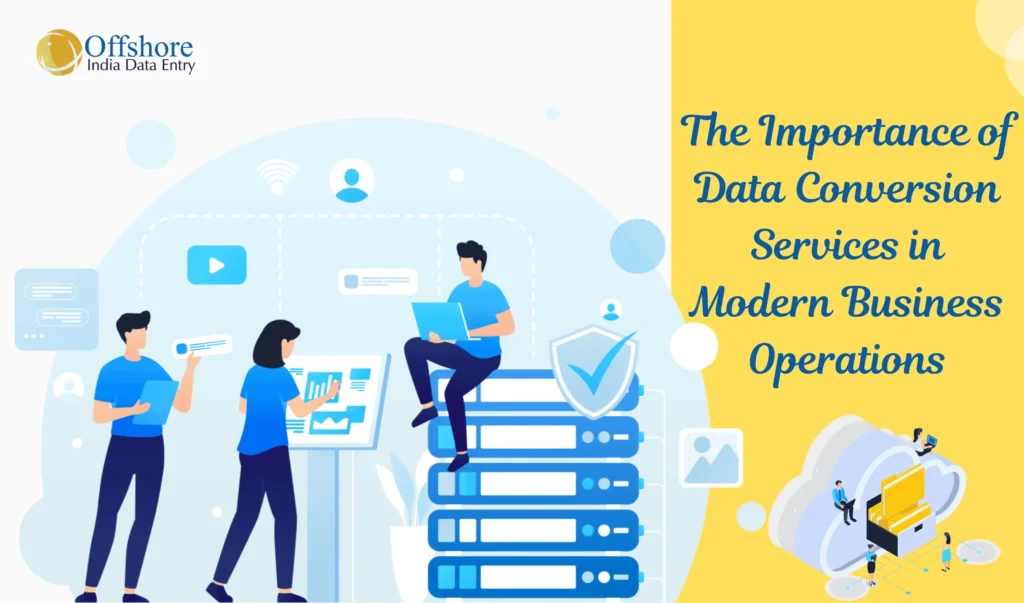
Data is an asset for businesses as it helps to make crucial decisions, boost client experiences, boost business growth, and finally a digital transformation. However, with the increase in the volume of business data, it becomes difficult for companies to convert them into a single format. This is where the role of data conversion services comes in.
With the advent of the latest technologies like artificial intelligence and big data analytics, having business data in a single format become a necessary factor. A leading data conversion service provider can certainly help you to manage the data conversion process and harness the complete potential of your business data.
So, What Exactly is Data Conversion?
Data conversion is the process of converting data from one format to another. This may include converting data in paper to digital format or converting data in one file format to another file format. Data extraction, data mapping, data cleansing, and data loading are the key processes that come under data conversion.
- Improvement in Data Accessibility :- Most probably the data that you have in your company will be in various formats. However, it is difficult for businesses to analyze such data as this becomes a daunting process. Also, it is difficult to share documents that are present in different formats. In such situations, if businesses are relying on the option of data conversion service providers, they can avoid such issues and ensure business efficiency.
- Quick Turnaround Times :- Time has a great importance in the business landscape. That is, if you are not able to make critical decisions on time, you cannot expect growth in your business. Business decisions are made on the basis of careful analysis of data. So, if the data is not available in the same format, it will be much more difficult for the stakeholders to make decisions on time. Thus, by converting the business data into a single format, you can make the analysis and data management process much faster.
- Clean Data Assets :- Your data conversion service provider can work as a tidy housekeeper. Wondering, how it works, right? Let’s see how it happens. When you are approaching a data conversion service provider, they will analyze your data, remove all inconsistencies, errors, and duplicates, and convert data into a format of your choice. Thus by involving in this data cleaning process, they will provide you a clean data set that you can rely on at any time.
- Cost Savings :- Want to reduce your spending on the data conversion process? Picking a reliable data conversion service provider is always the right decision. That is, if you are assigning data conversion tasks to the in-house employees in your company, you are using your workforce and the resources for this task. Also, when these employees are getting involved in this process, you are losing their participation in other core activities of the business. Thus, by choosing a leading data conversion service provider, you can save your costs and achieve a high return on investment.
- Outstanding Quality Outputs :- Data quality is a matter of great concern in the business world. If you can find a top data conversion service provider, you can be almost sure about data quality. What they do is that, they will use robust technologies and techniques to process the data. And they will conduct multiple quality checks before the final delivery to ensure the quality of data.
- Better Customer Experiences :- A correct analysis of data is much necessary to create good customer experiences. If the customer data that you have is accurate, you can craft services and products based on the client feedback. Thus, when you are building your products on the basis of client data, you are paving the way for better customer experiences. By partnering with a top-notch data conversion service provider, you can expect accurate data assets that will take you ahead.
- Encourages Remote Work :- The arrival of the COVID-19 pandemic introduced a new kind of work culture that is “remote work”. Even though, with the end of the pandemic, most of the companies revoked this system, still, there are companies that are continuing remote work. If the data assets of a company are available in multiple formats, it will be difficult for remote employees to get access. But with the help of top-notch data conversion service providers, companies can convert their large volumes of data into a single format and make the data-sharing process much easier.
- Makes Data Future-Ready :- We are living in an era, where technology is growing at a fast pace. If the data is present in papers, it will be difficult for you to share and also to explore the new tech that may come in the future. That is, if you are approaching a data conversion service provider, they will convert your documents into a standardized format. Also, it will facilitate for the smooth transition to new software and platforms.
Bottom Line
Now you may have understood why data conversion services become an essential factor for modern business operations. Data conversion service providers are really the forces that help your business to function smoothly and efficiently. They will help you to make intelligent decisions and smart moves in the business landscape. But you have to make the right choice regarding the data conversion service provider to get these advantages. That is check for the following matters before you partner with a data conversion service provider.
- Expertise.
- Security.
- Technology Used.
- Post-Conversion Support.
Offshore India Data Entry is a trustworthy data conversion service provider that offers customized data conversion solutions to the client. If you want to unveil the power of your data assets, connect us via support@offshoreindiadataentry.com
Businesses worldwide seek ways to manage their documents efficiently, as it is crucial for them, regardless of size. When managing the data strategically, they can simplify operations, mitigate costs, and increase productivity. Therefore, document management and document indexing are two fundamental approaches that help you manage data in this realm. Although both terms seem interchangeable, this signifies distinct processes with unique benefits. Thus, learning the difference between document management and document indexing is vital for making informed decisions that, in turn, enhance the efficiency and effectiveness of your organization.
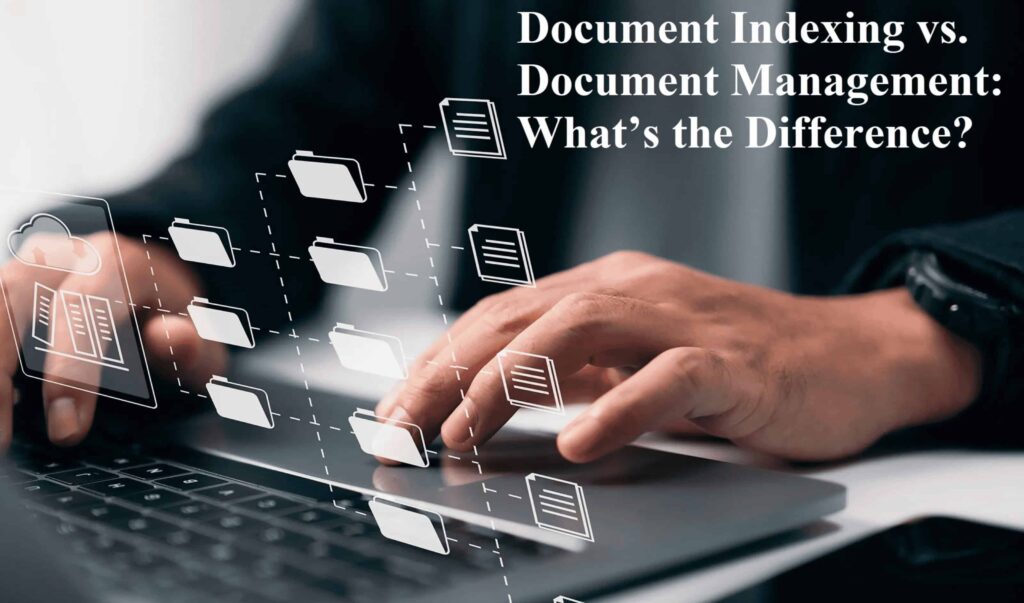
So, let’s get a comprehensive understanding of document management and document indexing. Also, how they differ and can be integrated to enhance your document management strategies.
Document Management
What is Document Management
Document management is the process of organizing and structuring documents throughout their lifecycle. This process includes document creation, storage, retrieval, sharing, and archiving. Moreover, with an efficient document management system (DMS), businesses can ensure that their documents are easily accessible, securely stored, and efficiently managed. As a result, they gain increased productivity and streamlined operations.
Document Management Benefits
- Increased Accessibility: A document management system enables employees to get access to essential documents rapidly and effortlessly from anywhere.
- Enhanced Collaboration: The system promotes better collaboration by allowing multiple users to access and manage documents at the same time.
- Cost Savings: Mitigating the dependency on physical documents reduces printing and storage expenses.
- Regulatory Compliance: An adept document management system assists in ensuring that every document is managed in compliance with industry regulations, mitigating the risk of legal issues.
- Security: Document management systems have stringent security features that safeguard sensitive data from unauthorized access.
Tools for Document Management
There are different tools that can assist businesses in efficient document management. So, let’s get familiarized with the popular ones.
- Microsoft SharePoint: An effective platform for document management and collaboration.
- Google Workspace: A set of cloud-based productivity tools with document management features.
- Dropbox Business: Provides secure file sharing and storage with the latest document management capabilities.
- DocuWare: An extensive document management solution with robust features for storing, retrieving, and securing documents.
Document Indexing
What is Document Indexing
Document indexing involves structuring a system to easily organize and retrieve information from documents. Additionally, it includes tagging documents with particular keywords or metadata, thereby enabling it to locate specific content quickly without manually searching through numerous files. Consequently, this process considerably increases the potential of document retrieval.
Document Indexing Benefits
- Easy Retrieval: Allows quick and efficient retrieval of specific data, saving time and increasing productivity.
- Increased Searchability: By tagging documents with significant keywords, indexing makes finding the exact information you require effortless.
- Enhanced Organization: Assists in keeping bulk volumes of data well-organized and easily accessible.
- Less Manual Effort: Automating the process mitigates manual data entry and searching requirements, minimizing errors and saving time.
- Better Data Management: Helps handle large datasets, enabling easier analysis and effective utilization of the information.
Document Indexing Tools
Let’s learn some of the popular tools that help in document indexing.
- ElasticSearch: A search engine that enables real-time indexing and searching of large datasets.
- Apache Solr: An open-source search platform that has advanced indexing and search capabilities.
- Microsoft Azure Cognitive Search: A cloud-based search service that provides indexing and search features.
Document Indexing vs. Document Management: Key Differences
Scope and Focus
From development to disposal, the document management process consists of the whole lifecycle of documents. This process aims at storing, organizing, sharing, and securing documents. However, digital document indexing focuses on retrieval. Specifically, it tags and collects documents to enable quick and easy access to specific information.
Applications
Different industries widely leverage document management systems for complete document management and collaboration. For instance, businesses that manage bulk volumes of documents and ensure regulatory compliance find these systems particularly beneficial. On the other hand, document indexing tools are mainly employed to improve searchability and retrieval efficiency. These are especially helpful for industries that address comprehensive data analysis and are required to access particular information easily and quickly.
Benefits
Even if both processes have significant benefits, they meet different requirements. Document management helps improve accessibility, enhance collaboration, save costs, and improve regulatory compliance and security. Conversely, document indexing facilitates easy retrieval, enhanced searchability, improved organization, mitigated manual effort, and better data management.
Integrating Document Management and Document Indexing
A good deal of organizations consolidates document management and document indexing systems to increase efficiency. By doing so, they enable extensive document management, from creation and storage to quick retrieval and analysis. As a result, businesses can ensure that their documents are efficiently organized, secured, and easily accessible when required. This, in turn, facilitates simplified workflows, quicker decision-making processes and enhances resource utilization across the organization.
Moreover, document management and document indexing help businesses to boost efficiency and reduce costs. By integrating both these, businesses can capitalize on their combined benefits. This helps documents be secure and well-organized, easily accessible, nurturing simplified workflows and improving collaboration. Ultimately, this contributes to benefits including saving time, increasing productivity, and enabling more effective data management.
Are you looking to know more about document management and document indexing?
Connect with us at support@offshoreindiadataentry.com to know more.
Over the past few decades, the Business Process Outsourcing (BPO) industry has undergone notable changes and developments. In addition, Virtual Assistant (VA) Services are one of the critical drivers of this evolution. It has a vital role in specialized BPO Services.
In detail, virtual assistants are experts who operate remotely with an organization, either full-time or part-time, and have the potential to manage routine tasks, specialized work, or occasional tasks. Also, they possess extensive proficiency and skills that improve operational efficiency, mitigate costs, and offer a competitive edge.
Now, let’s get an understanding of the role of virtual assistants in Business Process Outsourcing. Also, explore their specialized skills, the advantages they provide, and the trends developing the future of the BPO virtual workforce.
The Role of Virtual Assistants in BPO
Virtual Assistants have become imperative in BPO services thanks to their potential to manage a wide array of tasks. Their versatility is impressive, as they can handle customer inquiries, process transactions, provide IT support, and conduct data analysis.
Resultantly, VAs are seamlessly integrated into BPO workflows. Moreover, many companies have leveraged VAs to simplify their operations in this era of competitive business scenarios, increasing efficiency and customer satisfaction. So, let’s look at the variety of roles in which VAs benefit.
Administrative Support
Virtual assistants have an abundance of expertise in delivering administrative assistance remotely. Also, they are highly skilled in managing various tasks, including scheduling appointments, handling emails, organizing files, and preparing documents. By managing these tasks, VAs save valuable time so that you can focus on strategic priorities and core business activities.
Data Entry and Management
VAs can perform data entry, data analysis, market research, and database management tasks remotely. They possess analytical skills, attention to detail, expertise in data analysis tools, including Excel and Google Sheets, research abilities, and the potential to analyze and present data effectively. Their rigorous approach to data management facilitates streamlining operations and making informed decisions.
Customer Services
BPO virtual workforce handles customer inquiries, addresses issues, delivers product information, processes orders, and ensures customer satisfaction. Moreover, virtual assistants have expertise in customer service, problem-solving skills, familiarity with CRM systems, and the potential to manage different customer interactions efficiently. Leveraging this expertise, they enhance customer satisfaction and maintain strong client relationships.
Content Creation
Virtual assistants are experts in content creation. Therefore, they can create blog posts, articles, social media content, and multimedia assets customized to client requirements. Content-wise, VA skills include writing and editing, creativity, familiarity with digital marketing platforms, and social media management tools. Additionally, they possess SEO knowledge and the potential to adapt writing styles for diverse audiences. This expertise strengthens brand identity and prompts audience engagement in digital spaces.
Bookkeeping and Accounting
VAs hired for bookkeeping and accounting manage financial records, which involves monitoring expenses, handling invoices, and reconciling bank statements. In addition, virtual accountants prepare financial statements, evaluate financial data, and provide insights to facilitate businesses’ intelligent financial decisions. In bookkeeping, they record and categorize every financial transaction precisely, giving a clear view of the company’s financial status. Additionally, virtual accountants can manage tax preparation and filing, budgeting, and financial forecasting.
In addition to the above roles, virtual assistants’ expertise is utilized in roles such as technical support specialists, social media managers, market researchers, and virtual sales assistants.
Specialized VA Skills in BPO
Virtual assistants possess diverse skills in the BPO vertical. The technical skills include expertise in data management, IT support, and software development, which are vital for managing complex BPO tasks. In addition, virtual assistants possess necessary soft skills, including effective communication, problem-solving, and time management.
This ensures seamless and productive interactions with clients and team members. Moreover, virtual assistants with industry knowledge, including healthcare or finance, provide significant value by learning the distinct requirements and regulations of these sectors.
Benefits of Implementing Virtual Assistants in BPO
Cost-effectiveness
Virtual assistants are vital to significant BPO cost savings. They prevent the requirement for physical office space, mitigating overhead and operational expenses.
Flexibility and Scalability
Enable BPO firms to accommodate their resources as per the demand without extensive infrastructure change. This helps in managing seasonal workloads or sudden spikes in demand.
Enhance Efficiency
Improves efficiency by taking over recurring tasks facilitating core team members to focus on strategic activities.
Global Reach
Allow 24/7 operations, ensuring seamless service delivery for international clients.
Future Trends in the BPO Virtual Workforce
There are other factors that define the role of VAs in the future of the BPO industry. AI and Automation are expected to feature prominently in shaping the future of VAs and increasing their capacity for more intricate tasks.
Also, there is a trend towards remote work, which is also affecting the BPO industry as more organizations embrace the concept of remote working. This trend persists over time due to the improvement in technology and the variation of employees’ preferences in the workplace.
In this regard, it is assumed that VAs will broaden the sphere of BPO by expanding their specialization in such sectors as emerging markets and online businesses, including e-commerce and telehealth services.
In short, virtual assistants are transforming the BPO industry by providing specialized skills, enhancing efficiency, and delivering cost savings. However, as the BPO industry continues to progress, the role of virtual assistants will become even more relevant, led by technological advancements and the evolving trend towards remote work. Those BPO firms that use VAs in their operations maximize these benefits to remain competitive and meet the dynamic requirements of their clients.
Partner with Offshore India Data Entry to leverage the potential of Virtual Assistants Service for your business. Connect with us at support@offshoreindiadataentry.com
