[vc_row][vc_column][vc_column_text]
Among the many ways artificial intelligence (AI) is disrupting the BPO sector, data netry is seeking some of the most groundbreaking changes. Although it was a repetitive task that required continuous manual effort, it has now been transformed by using automation tools and intelligent systems. As businesses demand faster project delivery, higher accuracy, and cost-effective services, AI in data entry services is becoming a necessity. As automated data entry BPO solutions are gaining traction, let’s check how data entry automation is transforming the BPO landscape.
This blog explores the role of AI in data entry services and how automated data entry BPO solutions transform the industry.
[/vc_column_text][/vc_column][/vc_row][vc_row][vc_column][vc_single_image image=”4144″ img_size=”full”][/vc_column][/vc_row][vc_row][vc_column][vc_column_text]
The Effect of AI in Data Entry Services and BPO
- Error Reduction and Improved Accuracy – By following predefined rules, AI systems can validate information and reduce errors. That is to say, while considering medical billing with AI automation, the systems can instantly flag inconsistencies and missing fields. This forward-thinking approach significantly enhances the precision and performance of business processes. Thus, AI in BPO services is a means for organizations to increase data quality without heavily investing in it.
- Speed and Efficiency – Data automation empowers agents to handle thousands of entries in the same time it would take a human to process just a few. Moreover, machine learning algorithms learn from experience and reduce the margin of error. In this case, AI automation in data entry BPO services is ideal for high-volume projects without a proportional increase in headcount.
- Significant Cost Savings – Indeed, the initial investment to install AI tools is high. But the long-term benefits are significant. By integrating AI tools into the workflow, organizations can reduce the number of employees, process data faster, and ensure minimal errors with lower operational costs. In other words, BPO services providers can offer scalable and cost-effective services to clients without substantial spending and compromising on quality.
- Stronger Data Protection – With rising concerns around data privacy, AI also brings enhanced data protection features. Data automation tools restrict access, encrypt sensitive data, and track interactions, adhering to data protection regulations. That means they follow strict compliance protocols such as GDPR and HIPAA. This reduces the risk of data leaks from manual handling. Many organizations are taking strong data security measures, one of the key BPO trends in the industry today, and offering AI in data entry services.
- Seamless Integration of Systems – AI-driven data entry tools in automated data entry BPO solutions are designed to integrate seamlessly into existing systems such as CRMs, ERPs, and cloud storage platforms. This connectivity is crucial for ensuring that extracted data is automatically transferred into the right databases without manual intervention. Furthermore, by connecting various platforms in real-time, AI in BPO eliminates data silo and enhances collaboration. Moreover, it is a significant way to maintain consistent data across departments. In fact, the integration of multiple systems is one of the BPO trends that service providers integrate today.
[/vc_column_text][/vc_column][/vc_row][vc_row][vc_column][vc_column_text]
Challenges of Traditional Data Entry in BPOs
- Human errors
- Slow data processing
- Higher labor costs
- Scalability issues
Closing Remarks
AI in data entry services is not only changing data entry but also the entire BPO landscape. Data automation enables businesses to attain smarter, faster, and reliable services while ensuring competitive performance. So, automated data entry BPO services are indeed efficiency boosters. Still, it is essential for organizations to ensure that they maintain the right blend of technology and human skills. Moreover, more BPO trends are rolling out daily, integrating AI in BPO services.
Ready to leverage AI automation for your business? Drop your requirements at support@offshoreindiadataentry.com![/vc_column_text][/vc_column][/vc_row]
[vc_row][vc_column][vc_column_text]The American computer scientist, author, and entrepreneur Raymond Kurzweil once said that artificial intelligence will reach human levels by around 2029. Proving his statement, the potentials of AI and Automation are rising rapidly. These tremendous advancements in AI technology are bringing significant changes to multiple industries worldwide, and the Business Process Outsourcing Industry is no exception. The BPO industry is a key driver of operational efficiency for global enterprises. With the influence of AI and Automation, the industry enhances its efficiency, saving costs and increasing accuracy. As companies are focusing on a smarter and more agile future, AI-powered tools, machine learning algorithms, and robotic process automation (RPA) are enhancing the way businesses manage data processing, decision-making, and customer support. This blog explores how AI and automation in the BPO industry are setting new benchmarks for productivity and innovation.[/vc_column_text][/vc_column][/vc_row][vc_row][vc_column][vc_single_image image=”3958″ img_size=”full”][/vc_column][/vc_row][vc_row][vc_column][vc_column_text]
The Role of AI and Automation in BPO Industry
AI and automation in BPO industry benefit with speed, precision, and intelligence. While conventional data automation operates as per fixed rules, AI-driven data automation comprehends data patterns and makes real-time decisions. Moreover, machine learning models have the potential to evaluate vast datasets to identify trends, predict results, and enhance processes, enabling businesses to manage large-scale operations with greater accuracy. Technologies, including AI-based Optical Character Recognition (OCR), are increasing document processing speeds, while Natural Language Processing (NLP) improves customer interactions. This helps in avoiding inefficiencies, allowing BPO providers to deliver top-notch services with minimal manual intervention.[/vc_column_text][/vc_column][/vc_row][vc_row][vc_column][vc_column_text]
Key Areas Where AI and Automation are Impacting BPO
- Customer Support & AI Chatbots
In the customer service sector, AI chatbots and Virtual assistance are widely transforming operations by efficiently managing routine inquiries, mitigating response times, and thereby increasing customer satisfaction. The automated voice assistants streamline call center functions by responding to queries without human intervention. This reduces costs and ensures consistent service quality.
- Data Processing and Entry Automation
A significant component of AI-driven BPO services is Data automation. The OCR and intelligent document processing prevents manual data entry errors, considerably reducing processing time. This technology is substantially helpful for finance, healthcare, and legal outsourcing, where precision is key.
- Predictive Analytics and Decision-Making
Predictive analytics driven by AI assists BPO firms in offering actionable insights to their clients. By evaluating old data, AI can predict customer behavior, identify patterns, and improve decision-making processes. Maximizing these insights helps businesses in gaining a competitive edge by making informed strategic moves.
- HR and Recruitment Process Automation
AI simplifies talent acquisition for BPO firms through automated resume screening, AI-driven candidate assessments, and interview scheduling tools that drive recruitment while ensuring fair evaluation. This helps BPO firms onboard the right talent quickly, mitigating hiring expenses.
- Compliance and Risk Management
Regulatory compliance is vital for BPO firms operating in the finance, healthcare, and legal sectors. AI-powered risk management systems identify fraudulent activities, guarantee adherence to compliance standards, and reduce risks. By automating compliance checks, businesses can prevent penalties and legal complications.[/vc_column_text][/vc_column][/vc_row][vc_row][vc_column][vc_column_text]
Benefits of AI and Automation in BPO Industry
- Cost Reduction
By automating repetitive tasks, AI can mitigate operational expenses. BPO firms no longer require vast teams for data entry, customer support, or compliance management, resulting in considerable savings.
- Enhanced Efficiency and Productivity
Systems driven by AI improve process efficiency, finishing tasks in minutes instead of hours. The automated workflow enables BPO firms to manage high volumes of work with minimal errors, enhancing complete productivity.
- Better Accuracy and Mitigated Errors
The errors caused by manual data processing and reporting are costly. However, AI reduces these errors, ensuring accurate data management, mitigating rework, and improving service quality.
- Improved Customer Experience
Leveraging AI chatbots and personalized recommendations, BPO firms can offer tailored customer interactions. AI-based sentiment analysis tools aid in understanding customer feedback and enhancing service strategies.
- Scalability and Flexibility
BPO firms should manage varying workloads efficiently. AI-driven data automation enables seamless scalability, adapting to peak demands without requiring extra human resources.[/vc_column_text][/vc_column][/vc_row][vc_row][vc_column][vc_column_text]
Future Trends of AI and Automation in BPO Industry
- Hyperautomation in BPO – It consolidates AI, RPA, and analytics to create completely automated workflows. This trend is set to redefine how BPO firms function, improving efficiency at every level.
- AI-Powered Voice Assistants – Progressions in voice recognition AI are enhancing call center operations. These intelligent assistants have the potential to manage complex queries, mitigating human intervention.
- AI-Powered Personalization in Customer Support – AI improves customer service by evaluating user preferences and providing personalized solutions. This approach improves customer retention and loyalty.
- Integration of Blockchain with AI in BPO – Blockchain increases data security in AI-driven BPO operations. Also, it ensures trust in outsourcing services by enabling transparent and tamper-proof transactions.
- The Rise of AI-Driven Self-Service Portals – AI-driven self-service platforms enable customers to resolve issues without human support, mitigating operational expenses and enhancing user experience. Like a coin, there are two sides; along with the benefits, AI and automation in BPO industry also have some challenges and limitations. Job displacement concerns, high implementation costs, AI bias, ethical concerns, security, and data privacy risks are some of them.
[/vc_column_text][/vc_column][/vc_row][vc_row][vc_column][vc_column_text]
Key Insights
The evolution of AI and automation in BPO industry increases efficiency, accuracy, and scalability. Even though certain challenges, such as job displacement, and security concerns, exist, the benefits far outweigh the drawbacks. Additionally, companies that embrace AI-driven solutions will gain a competitive advantage in the global outsourcing market. Investing in AI today will prepare BPO firms for a smarter, more adaptive future.
Businesses looking to enhance their outsourcing operations should explore AI-driven solutions to stay ahead of the curve. Offshore India Data Entry will be your perfect partner to assist you in simplifying your BPO operations with efficient AI and automation solutions. Connect with us at support@offshoreindiadataentry.com to know more.[/vc_column_text][/vc_column][/vc_row]
[vc_row][vc_column][vc_column_text]You may have heard of the role of artificial intelligence in data entry services. AI in data entry is undeniably a game-changing strategy for thriving in the competitive business world. Moreover, data entry automation goes beyond traditional techniques that are highly reliant on manual effort. In fact, AI-powered data entry enables organizations to transform the way they capture, process, manage, and organize data. Through this blog, let’s explore the benefits of AI for data entry tasks and how data entry with AI reshapes modern data entry processes.[/vc_column_text][/vc_column][/vc_row][vc_row][vc_column][vc_single_image image=”3921″ img_size=”full”][/vc_column][/vc_row][vc_row][vc_column][vc_column_text]
- Automation of Repetitive Tasks – Automated data processing enables organizations to carry out data entry with automated systems. AI-powered tools and systems can handle repetitive tasks like data inputting, sorting, and organizing without much manual interventions. By adopting data entry automation, organizations can reduce manual labor and allocate them to strategic tasks. In this way, businesses can fly to new heights as the employees focus more on business development and other growth areas.
- Enhanced Data Accuracy – One of the notable benefits of machine learning data entry is the reduced rate of inaccuracy. While manual data entry can lead to typing errors, resulting in costly consequences such as inventory mismanagement, incorrect billing, and erroneous decision-making, automated data processing improves accuracy by leveraging capabilities such as machine learning and pattern recognition. Additionally, automated systems can flag errors and inconsistencies. In this case, organizations can detect and remove inaccurate entries.
- Unstructured Sources to Structured Outputs – A significant challenge in data entry is the extraction of relevant data from an unstructured dataset. However, AI-driven data entry excels in extracting data from unstructured sources and converting them into valuable information. Oftentimes, the speed of data processing is affected by difficulties in data extraction. Data entry with AI can eliminate such extraction issues and speed up the processes.
- Reduced Costs – There are many benefits of AI for data entry tasks, but the reduced cost is a substantial one that attracts more businesses to it. Traditional data entry is time-consuming and expensive. On the other hand, data entry automation reduces costs by automating tasks and cutting down the number of employees for non-core tasks. That is, by automating tasks using AI, organizations can eliminate the need to maintain a large team of data entry professionals, thereby lowering operational expenses. Also, in this way, organizations can reallocate employees to more strategic tasks.
- Enhanced Data Security – Data security is an all-time concern for businesses, especially when it comes to handling sensitive data. Artificial intelligence in data entry services enhances data security by automating processes. Furthermore, by incorporating data security measures such as access control and encryption, organizations can prevent unauthorized access to data. These measures not only aid in data protection but also ensure compliance with regulations. Additionally, automated data processing allows organizations to safeguard customer data, allowing them to foster stronger relationships with the customer base.
- Increased Process Efficiency – The benefits of AI for data entry tasks extend to increased process efficiency as well. Machine learning data entry allows businesses to streamline processes and thereby eliminate bottlenecks. Manual data entry processes can take time as they involve data sorting, inputting, and validation. By incorporating artificial intelligence in data entry services, processes can be streamlined with a single system, ensuring a smooth and seamless workflow. This approach not only reduces the time spent on each process but also aids in achieving higher productivity across departments.
- Faster Data Outputs – As we are aware, accessing data on time is essential for modern businesses. Data entry with AI accelerates the entire process and ensures faster outputs in the given time frame. Unlike traditional data entry, AI-powered data entry can extract data from large datasets in less downtime. In addition, accurate data by hand allows businesses to respond swiftly to customer inquiries, inventory management, and other crucial business operations.
[/vc_column_text][/vc_column][/vc_row][vc_row][vc_column][vc_column_text]
Final Thoughts
In essence, the benefits of AI for data entry tasks are numerous. AI is transforming mundane and repetitive data entry tasks into effortless processes. By automating repetitive tasks, AI-driven data entry is providing results with high accuracy, faster outputs, and increased internal efficiency. As the technology world is unlocking new capabilities for AI, its role in data entry becomes prominent, paving the way for smarter, faster, and more secure processes. If you haven’t adopted AI in data entry yet, this is the time. Collaborate with a service provider that offers AI-powered data entry.
If you are looking for a data entry service provider who leverages AI in data entry, your search is over. We are Offshore India Data Entry, an AI-driven data entry service provider. Connect us at support@offshoreindiadataentry.com for detailed information![/vc_column_text][/vc_column][/vc_row]
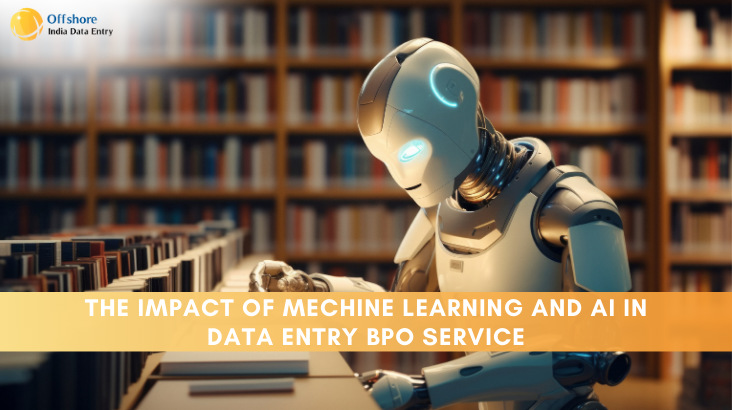
The realm of data entry is evolving with the integration of Artificial Intelligence/AI and machine learning. New updates in artificial intelligence and machine learning are rolling out progressively and are conquering the BPO data entry sector. With the help of machine learning, BPO data entry is creating waves in the outsourcing world by seamlessly providing human-level efficiency. Recently, data entry service providers began to incorporate AI and machine learning in data entry BPO services, and the impact is nothing short of efficiency. With the integration of this powerful duo, BPO operators can drag the most out of their services and work towards delivering more streamlined services. However, these technologies are not just integrations to smoothen workflow, but also integral components of data entry processes today. Come tune in and explore the impacts of AI and machine learning in data entry BPO services.
Automation with Machine Learning and AI in BPO
Artificial Intelligence is a game-changer in the world of BPO services. However, the combination of machine learning and AI in BPO speaks for boundless innovation. With their revolutionary amalgamation, data entry has become effortless yet more qualitative than ever. By integrating AI and machine learning in BPO, service providers reduced the traditional data entry challenges and unlocked operational efficiency. Let’s have a look at the major BPO automation technologies operators use.
Optical Character Recognition(OCR)
BPO service providers leverage OCR technology in BPO automation. Just like machine learning automation technologies like IDC, this tool helps in extracting information from physical as well as digital documents. By leveraging AI-powered OCR technology, data entry service providers convert data from ordinary formats to machine-readable formats, which aids in data entry automation.
Intelligent Data Capture(IDC)
Intelligent Data Capture utilizes AI and machine learning automation to extract data from physical datasets like documents. This tool helps in data entry automation by capturing information from scanned documents and printed media, leveraging OCR technology. However, this one takes a step beyond OCR by analyzing the context. That is, IDC understands, organizes, and interprets data relevant to the context.
Natural Language Processing(NLP)
Natural Language Processing is a branch of AI that utilizes machine learning for automation techniques. This technology is focused on analyzing and interpreting human languages. Today, organizations have large quantities of data in voice and text formats. Data entry operators use this technology to read and respond to data in real-time, by analyzing the context and intended sentiments.
Impact of Machine Learning and AI in BPO
Increased Efficiency through Automation
Artificial intelligence facilitates the automation of repetitive tasks in BPO. As we are aware, data entry involves a huge amount of data to be entered and this mundane task can be completed within short turnaround times with data entry automation. Moreover, machine learning in data entry BPO services enhances the process of data entry by analyzing and responding just like that of humans.
Error-Free Data Entry
Error-free data is the core component of successful businesses. Data entry mistakes can cost heavily and human errors are inevitable, and this results in customer dissatisfaction. Leveraging AI-powered tools in Data Entry BPO services helps operators deliver data entry services with fewer errors, avoiding redundancies. Additionally, machine learning BPO tools learn from patterns and mitigate the risk of errors from time to time.
Operational Cost Reduction
By utilizing AI and machine learning in data entry BPO services, operators can reduce the cost of hiring and maintaining a large team of manual data entry specialists. There is an initial investment in technologies here. But the resulting efficiency will speak for your investment. Moreover, you can scale up or scale down the tools according to your working modes and requirements.
Better Customer Experience
Customer satisfaction is a foundational aspect behind the success of any business. AI and machine learning in BPO data entry services give you opportunities to provide tailored services. By learning customer behaviors, machine learning enables businesses to give customized solutions and meet the expectations of the clients. Moreover, customized solutions result in better customer experiences.
Predictive Analytics
As today’s businesses are heavily driven by data, AI and machine learning are highly beneficial in data entry BPO services. By analyzing past data, AI can predict customer behavior and market trends for the future. This will enable BPO data entry service providers to make informed decisions and work for the future of the business. In reality, BPO automation, especially data entry automation works wonders if you are up for automating your workflow. Moreover, it reduces the risk of overestimations and irrelevant predictions.
Improved Data security
Data security is a top priority in data entry services. As they handle sensitive information of diverse clients, managing them properly and keeping them secure is of paramount importance. Machine learning and Artificial Intelligence in BPO Data Entry services detect even minor security threats. But, how does it work? Simply put, machine learning in BPO learns from past data, spots suspicious activities, and takes protective measures to safeguard sensitive data.
Future of Data Entry with AI and Machine Learning
The future of data entry BPO looks promising with the immense opportunities technologies provide. Moreover, organizations have witnessed the vitality of integrating digital tools in BPO. As BPO automation is gaining momentum with its revolutionary features, the time is in favor of the service providers than ever before. Indeed, the potential of AI and machine learning BPO is going to reshape the outlook of the BPO data entry industry. Furthermore, we can expect advancements such as speech-to-text automation in BPO, in the upcoming years. However, the major thing we must address here is the company’s adaptation to advanced tools. While AI automates repetitive routine tasks, machine learning refines the process by analyzing datasets. In brief, leveraging this duo can enhance the accuracy and efficiency of BPO data entry services.
Bottom Line
With the combination of AI and ML, operators can bring up intricate projects and deliver them efficiently, without uncertainties. Also, the combined strength of these AI and ML makes operators efficient enough to provide services that meet the demands of today’s data entry needs. It’s important to realize that the world is on the run to unlock more technology. Although artificial intelligence is prominent, machine learning benefits in BPO are notable as well as reliable. And, adopting digital tools to fit in the ever-evolving landscape of data entry is also critical. We have a note for the outsourcing customers, partner with an advanced service provider! Leveraging technology is so crucial for staying current and unlocking efficiency. Want to partner with a top-tier service provider? Connect us at suppport@offshoreindiadataentry.com.
In the very highly competitive business world, the Business Process Outsourcing(BPO) sector is vying for operational efficiencies and accurate performances. Among these is data automation, the biggest boon for BPO today. This innovation automates many data-driven processes, giving clients the best combination of service speed, accuracy, and much better service. This blog covers the prominence of data automation’s advantages within BPO, as it relates to increasing efficiency and accuracy.
What is Data Automation in BPO?
Data automation relies upon several technologies including artificial intelligence(AI), machine learning(ML), and robotic process automation(RPA), to work out mundane, repetitive, and time-taking tasks. Under BPO’s working process, data entry, data processing, document management, and report generation remain the easy targets for these automated bindings. With such fields being now handled with automation, many of the errors that occur could be brought down to zero.
Greater Efficiency of Operations
Operative efficiency is one of the biggest advantages brought about by data automation in BPO-huge enhancement in operative efficiency. Numerous people would think that labor-intensive processes are slow and prone to errors. BPO companies, therefore can handle bigger volumes of work in less time and thereby shoot up project turnarounds.
Automation speeds up data processing and does even complex bookkeeping tasks within seconds that otherwise might require many hours.
Reduced turnaround time improves productivity within a given organization.
Such automation systems work 24 hours a day, 7 days a week, and require no timeouts, providing continual operation and output. The use of automation technologies allows BPOs to beat deadlines, extend their tepid customer base, and make better profits in the process.
Improved precision and quality of data
Manual processing and entry are prone to errors. Data automation eliminates these inaccuracies, giving veritable results that cannot be faulted. Automated systems work according to the rules established earlier, thus the risk of mistakes remains low.
Automated processes ensure perpetual and ensured accuracy, stability and reliability of data over time.
These benefits enhance the quality of services provided to clients that establish good relationships based on verified data for sound decision-making.
Cost Optimization
In BPO, substantial cost savings can be achieved through data automation. The company can reduce labor dependence, thereby reducing the cost of operation, through the automation of repetitive work activities. Automation tools can perform an entire gamut of tasks that could otherwise require a large number of workers.
Labor costs are also reduced since automation reduces the need for large teams to handle data-related tasks.
With time, business acquires high returns on investment (ROI) since more efficiency and output are acquired without necessarily hiring continuously.
It provides high-quality services at a reduced rate and thus helps gain new customers and retain the existing ones for a BPO firm that wishes to be ahead of the game.
Scalability and Flexibility
Automation also provides unparalleled scalability, so data automation BPO companies comfortably manage rising volumes of data. Whether maintaining hundreds of entries or millions, an automated system can scale up to keep pace with an expanding workload without requiring hands-on adjustments.
This easily makes it scalable both up and down, making it easy to adjust the business needs without having to hire more staff.
They could handle enormous amounts of data and still do it fast and without lost quality.
This flexibility allows BPO companies to grow their operations without continuously expanding their workforce, ensuring smooth, cost-effective scaling.
Incremented Compliance and Security
Another benefit of data automation in BPO is greater compliance with industry standards and better data security. Because automated systems operate within specific standards, the data is processed under the best industry requirements that minimize the possibility of non-compliance.
Automated systems follow strict protocols, ensuring consistent adherence to regulatory requirements.
Self-service platforms utilize data security features, such as protecting sensitive information from being accessed without permission.
Because of this, the minimized human intervention requirement minimizes the possibility of data breaches and handling errors.
To the BPO company dealing in sensitive information like financial records or medical, automation provides the necessary security and regulatory compliance to protect both the company and its clients.
Conclusion: The future of BPO lies in data automation.
As businesses continue to multiply data production, BPO data automation demand will increase. With all these factors of efficiency and accuracy along with the help of cost-cutting measures and scalability, automation is a must in BPO companies to remain competitive.
BPO companies can bring service quality improvement, adhere to clients’ demands even better, and future-proof their operations if they take on automation technologies. Whether you’re looking to improve efficiency or boost data accuracy, automation happens to provide the perfect answer to today’s data-driven competitive business environment.
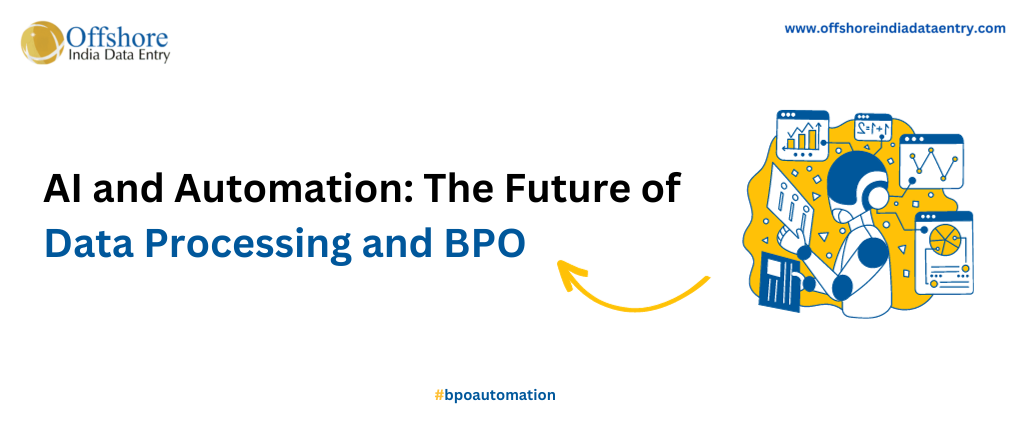
The data processing and business process outsourcing (BPO) landscapes have been fundamentally altered in recent years by emerging technologies like artificial intelligence and automation. These advanced technologies are enabling BPO companies to unlock unprecedented levels of efficiency and productivity.
For BPO service providers, integrating the latest AI and automation tools and techniques is critical for managing large-scale client projects and scaling operations rapidly. This article will explore the key areas where AI and automation are providing immense value in data processing and business process outsourcing.
Optimizing Workflows with Intelligent Automation
AI-powered systems have equipped data processing and BPO firms with the ability to organize and process massive volumes of data. Machine learning algorithms can quickly replicate repetitive human tasks to categorize and analyze real-time data sets.
Natural language processing (NLP) techniques further enhance the capacity to structure unstructured data efficiently. NLP can interpret text data like customer inquiries, feedback, and documents to convert them into structured formats. This allows the data to be processed and analyzed effectively by automated systems.
Such innovations allow companies to focus on core competencies while AI-powered software handles mundane, repetitive tasks. The output data will be accurate, with anomalies flagged early through continuous tracking.
For example, invoice processing workflows can be automated by using optical character recognition to extract key information. The data gets input into accounting software without human data entry, saving time and reducing errors.
Driving Data Quality Through AI
AI and automation bring tremendous improvements to data quality. Studies show automated data processing can reduce human error rates by up to 50% while improving data accuracy by up to 40%.
Intelligent data analytics solutions monitor performance metrics continuously throughout the operation. They can detect common data quality issues like:
- Duplicate data entries
- Missing mandatory information
- Outdated records
- Inaccurate or incomplete data
- Invalid formats
Integrating these checks enhances data reliability and consistency. BPO companies leveraging AI deliver faster services by automating quality control and resource allocation. Their offerings stand out through data-driven insights and recommendations.
Scaling Up Through AI Adoption
The innovations brought forth by AI and automation allow data processing and BPO firms to expand rapidly. Studies show that automating repetitive tasks can increase productivity by over 50%.
By taking over high-volume tasks like data entry, extraction, and processing, these technologies free up human resources to focus on high-value business activities.
Automation in areas like data processing, customer support, and back-office functions optimizes budgets and resources. Companies can then invest more in strategic initiatives to drive growth.
For example, analysis of customer data and feedback identified opportunities to expand into new geographical markets and industry verticals. One firm launched services for the healthcare sector after AI-driven insights revealed unmet needs.
Reducing Costs and Time Requirements
Transitioning from manual methods to AI-powered automation significantly reduces costs and time requirements. Studies indicate that AI automation can reduce business process costs by about 20–30%.
Mundane and repetitive tasks like data entry, customer service inquiries, appointment scheduling, and email responses can be handled by intelligent AI chatbots and virtual assistants. This removes the need to hire large support teams for basic functions, saving significantly on salaries, training, infrastructure, and other overheads.
For example, automating routine customer service interactions through chatbots can reduce response times by up to 50% or more. Email responses can be generated instantly instead of waiting hours or days.
By using real-time data to optimize business processes, AI reduces wasteful ad-hoc efforts. Costs and delays are minimized through data-driven resource planning and task prioritization.
Informing Business Strategy and Decisions
The analytical capabilities unlocked by AI deliver invaluable business insights for data processing and BPO companies. Advanced algorithms can quickly analyze massive amounts of data—up to millions of data points in seconds.
These insights help create data-driven strategies tailored to market conditions and customer preferences. For example, analysis of customer churn patterns allowed one firm to identify a lack of self-service options as a top reason. This led to the decision to invest in AI-powered chatbot capabilities.
Key performance indicators are monitored to guide informed decisions at each step. Rather than relying on guesswork, businesses can leverage AI-generated analytics. This gives executives the confidence to spot growth opportunities and take decisive action.
Enhancing Risk Management and Security
Integrating AI enhances the capacity of BPO companies to detect threats and mitigate risks. Machine learning models can automate tasks like security audits, vulnerability checks, and penetration testing.
These techniques enable continuous monitoring of networks and early anomaly detection. As BPO service providers manage sensitive client data, robust AI security is crucial.
AI algorithms also help create strategies for regulatory compliance and policy adherence, which are vital for the data services sector. They facilitate keeping up with frequent changes to cybersecurity and privacy laws.
AI: The Future of Data Processing and Outsourcing
The meteoric rise of artificial intelligence has fueled a transformation in the business process outsourcing and data processing sectors. From optimizing workflows to enhancing data quality, AI innovations are proving to be a game changer.
For BPO service providers, integrating the latest automation and analytics tools is now a competitive necessity. The efficiencies unlocked allow companies to deliver higher value to clients across functions.
As AI capabilities continue to evolve, they will emerge as the foundation that enables data processing and BPO firms to scale new heights. Companies that embrace these technologies will gain a distinct strategic edge.
Accelerate Your Business Processes with AI-Powered Automation
Achieve up to 50% faster turnaround times, 20% lower costs, and 97% accuracy by leveraging Offshore India Data Entry‘s AI-powered data processing service and business process outsourcing solutions. Our machine learning and automation capabilities handle high-volume, repetitive tasks to significantly reduce expenses. This allows your team to focus on core competencies while our predictive analytics and quality algorithms maintain precision.
With intelligent Al and automation, scale rapidly without compromising on compliance or quality. We identify process optimization opportunities tailored to your operations for enhanced efficiency. Transform outsourcing through our AI advantage, which drives strategic insights and unlocks capacity. Contact our business process outsourcing experts today for a free assessment at support@offshoreindiadataentry.com
